
By Dr. Kathryn Dundas, MD, CCFP
Sublime Life | The Journal
Mitochondria are having a moment right now.
They’re being discussed across longevity medicine, metabolic health, and even mainstream wellness — and for good reason.
Mitochondrial dysfunction is now recognized as one of the central features of aging, sitting at the intersection of insulin resistance, cardiovascular disease, neurodegeneration, and hormonal change.
In other words — many of the patterns we’re seeing more of clinically.
We’ve always been taught that mitochondria are the “powerhouses” of the cell.
That’s true.
They produce ATP — the energy currency your body relies on — by converting oxygen and nutrients into usable energy.
But what’s becoming clearer in the research is that they don’t work in isolation.
Mitochondria function as dynamic networks.
They:
So yes — they are your energy generators.
But they are only as strong as the system they sit within.
A useful way to think about this is like a string of Christmas lights.
You are only as strong as the weakest connection, and if one is “out” and can’t communicate with the network issues develop.
If one part of the system is underperforming — oxygen delivery, nutrient support, recovery — the whole chain becomes less efficient.
Energy doesn’t disappear.
It becomes harder to produce and harder to access.
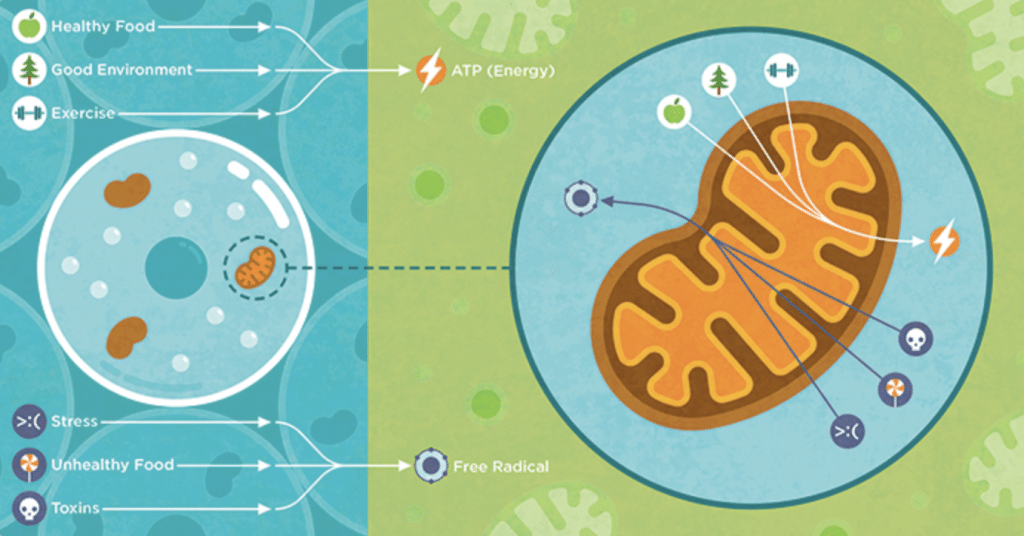
This is where most people get it wrong.
When energy drops, the instinct is to add more:
But energy production doesn’t just depend on input.
It depends on capacity.
Capacity is your body’s ability to take oxygen and nutrients and convert them into usable energy.
And that process has very real requirements.
Oxygen has to reach the cell — which depends on iron status.
Nutrients have to be available — but not in excess.
Cofactors like B vitamins, vitamin C and magnesium have to be present to run the biochemical pathways.
And the system has to be receiving the right signals — through movement, light, and rhythm — to actually use that energy.
This is where the idea of “feeding mitochondria” needs to be understood properly.
Yes — when demand increases, the body needs more.
More movement, more training, more output — all increase the need for oxygen, nutrients, and support.
But more only helps if your body can actually use it.
If capacity is not there, increasing input doesn’t create energy.
It creates strain.
Before you push for more, make sure your body can support it.
Otherwise, what should feel energizing starts to feel depleting.
And over time, downstream systems begin to reflect that strain.
Hormonal signaling becomes less efficient.
Sleep quality declines.
Changes in hair, digestion, and body composition can emerge.
These are often interpreted as primary hormone issues, but they are frequently secondary to impaired energy production at the cellular level.
This is something I see often in high-performing patients.
They are doing all the right things:
But over time, they start to feel:
And the instinct is to look at thyroid or hormones first.
Sometimes that’s appropriate.
But often, those systems are responding to something more fundamental:
The energy-producing system underneath them is under strain.
Mitochondria don’t just need fuel.
They need oxygen, structure, signal — and recovery.
Capacity is not built by pushing harder.
It’s built by matching demand with support, and allowing the system to adapt.
Seasonal transitions make this more visible.
As light exposure changes and routines shift, mitochondrial signaling changes with it.
Less light. Less movement. More metabolic load.
And the system becomes less efficient.
What people feel is simple:
Low energy.
The goal is not to override that signal.
It’s to understand it.
Because when the system is supported properly, energy doesn’t need to be forced.
It returns.

PRACTITIONER PICKS
Red Light Bed
Support mitochondrial signaling
Light is not just environmental — it’s biological input.
Red and near-infrared light support cellular energy production and help re-establish rhythm when natural light exposure declines.
Vital Iron — Sublime Life
Support oxygen delivery
Energy begins with oxygen reaching the cell.
Iron supports this process, allowing mitochondria to produce energy efficiently — particularly under higher physical or metabolic demand.
For Deeper Reading
Emerging research continues to reframe mitochondria as dynamic, networked regulators of cellular function — not simply energy producers.
Picard, M. et al. have demonstrated how mitochondrial structure, signaling, and responsiveness to environmental inputs influence systemic physiology and stress adaptation.
Picard’s review on mitochondrial signaling:
→ Picard M. et al. Mitochondrial Psychobiology. Current Opinion in Behavioral Sciences.
Energy is not something you force.
It’s something your system is designed to produce — when supported correctly.
Make presence your protocol. ✦ Sublime Life
Dr. Kathryn Dundas MD, CCFP
Founder, Medical Director Sublime Life