
By Dr. Kathryn Dundas, MD, CCFP Sublime Life | The Journal
For years, the story seemed simple.
Free radicals cause damage.
Damage causes aging.
Therefore, antioxidants must slow aging.
It sounded logical.
In fact, an entire generation of supplements was built around that idea. The stronger the antioxidant, the better. The more antioxidants, the healthier the cell.
But biology turned out to be much more nuanced.
One of the most important discoveries in longevity science is that the body doesn’t simply respond to stress.
It learns from it.
And sometimes, when we suppress those signals too aggressively, we suppress the very adaptations we are trying to create.
The Antioxidant Paradox
Free radicals have been painted as the villains of aging.
And certainly, excessive oxidative stress can damage proteins, DNA, cellular membranes, and mitochondria.
But free radicals are not only damaging molecules.
They are also signaling molecules.
Your cells use small bursts of oxidative stress to communicate.
To repair.
To adapt.
To become stronger.
This concept is known as hormesis.
Hormesis describes the phenomenon where a small, controlled stress makes the body more resilient.
Many of the most powerful longevity interventions work precisely because they challenge the body.
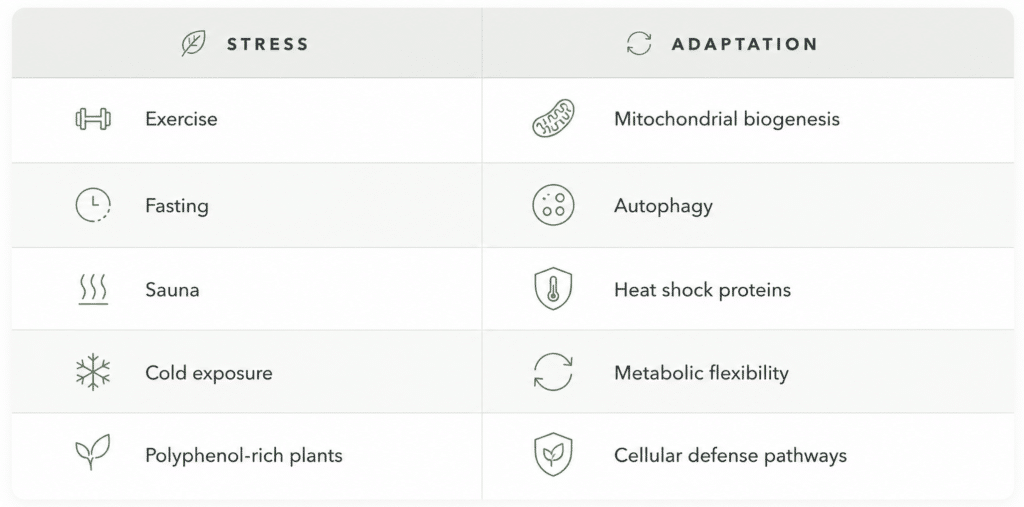
The goal is not to eliminate stress.
The goal is to become more resilient to it.
The Study That Changed the Conversation
One of the landmark studies in this field was published by Ristow and colleagues in 2009.
Researchers followed participants undergoing exercise training while taking either placebo or a combination of:
• 1,000 mg Vitamin C daily
• 400 IU Vitamin E daily
The expectation was simple:
More antioxidants should produce better results.
Instead, the opposite happened.
The antioxidant group demonstrated reduced activation of pathways involved in mitochondrial adaptation and experienced less improvement in insulin sensitivity compared with the placebo group.
Why?
Because exercise creates a temporary increase in reactive oxygen species (ROS).
While excessive ROS can be harmful, the short-lived burst generated during exercise serves as an important signal.
That signal activates:
• PGC-1α
• Mitochondrial biogenesis
• Endogenous antioxidant production
• Improved insulin sensitivity
• Enhanced metabolic flexibility
In other words, exercise is telling the body:
Build me stronger.
When large doses of isolated antioxidants suppress that message, adaptation may be reduced.
The lesson wasn’t that antioxidants are bad.
The lesson was that timing matters.
What Most Longevity Physicians Do
This is where longevity science becomes practical.
Many physicians who work in performance and longevity medicine recommend avoiding high-dose antioxidant supplements immediately around exercise.
A simple rule of thumb is:
Avoid large doses of Vitamin C and Vitamin E for approximately four hours around your workout.
A practical example might look like this:
Morning Workout
Before Exercise
✓ Water
✓ Electrolytes
✓ Coffee if desired
Avoid:
• High-dose Vitamin C
• High-dose Vitamin E
After Exercise
✓ Protein
✓ Electrolytes
✓ Creatine
Later In The Day
✓ Vitamin C if taking
✓ Vitamin E if taking
An important nuance:
This concern primarily applies to high-dose isolated antioxidant supplements.
It does not appear to apply to whole foods.
Eating blueberries after a workout is not the same thing as taking 1,000 mg of Vitamin C.
Colourful fruits and vegetables remain among the most powerful longevity tools we have.
Other supplements generally considered compatible with exercise adaptation include:
• Creatine
• CoQ10
• Magnesium
• Omega-3 fatty acids
Polyphenols occupy an interesting middle ground. They may create beneficial stress signals of their own and, in many cases, appear to support adaptation rather than blunt it.
The Rise of Mitohormesis
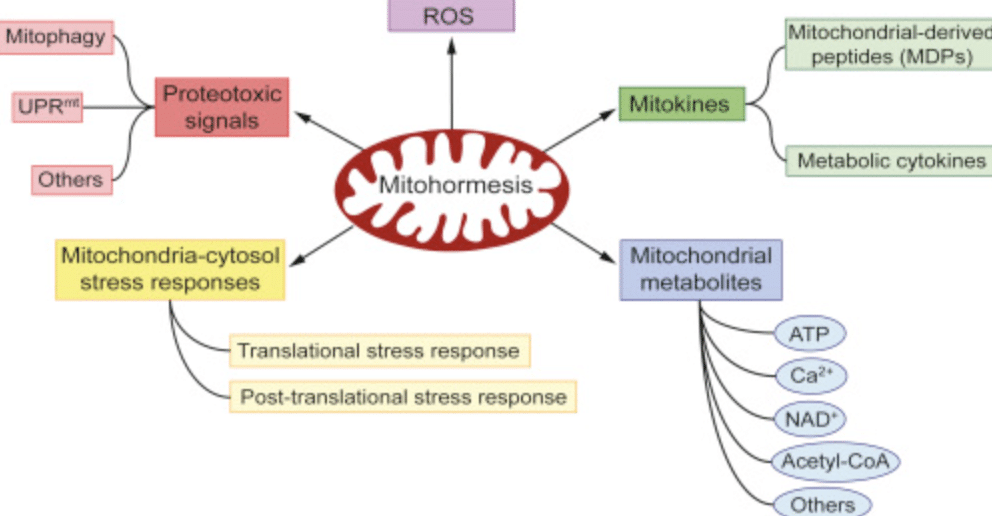
A newer concept emerging in longevity science is called mitohormesis.
The idea is beautifully simple.
Mitochondria—the tiny energy-producing structures inside our cells—actually become healthier when exposed to manageable stress.
Exercise.
Fasting.
Heat.
Cold.
Even certain plant compounds.
These all create signals that encourage mitochondria to become more efficient, resilient, and adaptive.
Rather than shielding ourselves from every challenge, we are learning that the body often grows stronger because of challenge.
The Body’s Own Defense Systems
One of the most fascinating discoveries in modern physiology is that many compounds once thought to work simply as antioxidants may actually work by activating the body’s own defense systems.
Instead of acting like a fire extinguisher, they help the body build a better fire department.
Scientists have identified a pathway known as Nrf2, sometimes called the master regulator of cellular defense.
When activated, Nrf2 helps stimulate:
• Glutathione production
• Superoxide dismutase (SOD)
• Catalase
• Cellular detoxification pathways
• DNA repair systems
In other words, the body already possesses extraordinary antioxidant machinery.
The goal is not to replace it.
The goal is to support it.
The Supplements That Support Adaptation
This is where the conversation becomes particularly interesting.
Some supplements appear to support adaptation rather than blunt it.
Instead of suppressing the signal, they help the body respond more effectively to it.
Creatine
If there is one supplement that has quietly become a favourite among longevity physicians, it is creatine.
Most people still think of creatine as a bodybuilding supplement.
In reality, creatine supports one of the most fundamental systems in the body: cellular energy production.
Creatine increases phosphocreatine stores, helping regenerate ATP—the energy currency of the cell.
This supports:
• Muscle performance
• Recovery
• Neuromuscular function
• Brain energy metabolism
Importantly, creatine does not appear to interfere with ROS signaling.
Instead, it helps support the body’s response to training.
Research consistently demonstrates benefits for:
• Strength
• Lean muscle mass
• Functional capacity
• Exercise performance
Emerging evidence also suggests benefits for cognitive resilience, mental fatigue, and healthy brain aging.
Typical dosing:
• 3–5 grams daily for general health and performance
• Up to 10 grams daily is sometimes used in cognitive and neurological protocols
Unlike many supplements, creatine supports two of the strongest predictors of healthy aging:
Muscle and brain function.
The Longevity Shift
One of the biggest shifts occurring in longevity medicine today is a move away from suppressing stress and toward supporting adaptation.
The question is no longer:
“How do I eliminate every stressor?”
The question is:
“How do I help my body become more resilient?”
Exercise becomes a mitochondrial stimulus.
Fasting becomes a cellular clean-up signal.
Sauna becomes a heat adaptation signal.
Cold exposure becomes metabolic training.
Many plant compounds become activators of repair pathways rather than simple antioxidants.
The goal is no longer to override biology.
The goal is to support biology.
Why This Philosophy Led To Sublime Life Supplements
The first shipment of Sublime Life supplements arrives this week.
I’ll admit something.
They feel a little like my babies.
Bringing them to market has taken years.
But the reality is that they have been developing in my mind for much longer than that.
Long before I became a physician, I was fascinated by performance, recovery, nutrition, and resilience as a competitive athlete. Medicine simply gave me a deeper language for questions I had already been asking for most of my life.
Over nearly three decades of practice, I have watched patients struggle with the same frustrations.
Too many bottles.
Too many overlapping ingredients.
Supplements that looked impressive on the label but ignored physiology.
Products that focused on isolated ingredients rather than understanding how the body actually works.
When I began developing the Sublime Life line, I wasn’t interested in creating supplements based on trends.
I wanted to create formulations based on systems.
Vital Iron
Iron doesn’t work in isolation.
It requires vitamin C, folate, B12, and copper
to support healthy absorption, transport, and utilization.
The goal wasn’t simply to provide iron.
The goal was to support the entire pathway.
Vital Creatine
Rather than creating another basic creatine product, we focused on three interconnected aging systems:
• ATP regeneration through creatine
• Mitochondrial energy support through acetyl-L-carnitine
• Muscle preservation through HMB
Together they support what I often call the muscle–mitochondria–brain axis of healthy aging.
Adapt Balance
Adapt Balance was designed to support healthy stress adaptation pathways rather than simply masking fatigue.
Brain Flow
Brain Flow was developed to support cognitive resilience, circulation, focus, and cellular energy metabolism.
Cellular Shield
Cellular Shield was built around the concept of resilience.
Not by shutting down every stress signal, but by supporting the body’s own cellular defense systems and adaptive capacity.
Vital Omega
Omega-3 fatty acids remain among the most evidence-supported nutrients in longevity medicine.
They support cardiovascular health, brain function, cellular membrane integrity, and healthy inflammatory balance.
Vital D
Vitamin D is often thought of as a bone nutrient, but its influence extends far beyond skeletal health.
Vitamin D receptors are found throughout the body, influencing immune function, muscle function, metabolic health, and healthy aging.
Vital Frame
Recently approved with its Natural Product Number, Vital Frame was developed to support healthy aging from a structural perspective, including bone, muscle, and connective tissue health.
One ingredient I fought particularly hard to include was boron.
Many people are familiar with calcium and vitamin D. Far fewer know about boron despite growing evidence suggesting it may play important roles in bone metabolism, vitamin D utilization, hormone regulation, and healthy aging.
For me, it represents exactly the type of overlooked but meaningful ingredient that deserves more attention.
Each formulation supports a different physiological system, but all share the same philosophy:
Support the body’s intelligence rather than override it.
A Final Thought
One of the reasons I love longevity medicine is that it continually reminds us how remarkable the human body really is.
The goal is not to overwhelm it with more and more interventions.
The goal is to understand what it is trying to do and support it appropriately.
Sometimes that means exercise.
Sometimes it means sleep.
Sometimes it means nutrition.
Sometimes it means targeted supplementation.
And sometimes it means testing.
One of the most useful tools we use at Sublime Life is the Cellular Nutrient Assay, which measures nutrient status inside the cell rather than simply in the bloodstream.
Because if we are going to support the body’s systems intelligently, it helps to know which systems actually need support.
If you are interested in learning more about any of the new Sublime Life formulations—or would like to be notified when a specific product becomes available—simply reply to this email with the product name.
As always,
Make Presence Your Protocol.
Dr. Kathryn Dundas, MD, CCFP
Founder & Medical Director
Sublime Life