
By Dr. Kathryn Dundas, MD, CCFPSublime Life | The Journal
For years, many of us have been handed the same narrative about aging.
After a certain birthday, the goal becomes maintenance. Hold on to your muscle. Hold on to your memory. Hold on to your independence. Slow the decline if you can.
The message is subtle but relentless: the best years of your body are behind you.
But what if that story isn’t entirely true?
A study published this year by researchers at Yale University challenges one of the most common assumptions about aging. Following more than 11,000 older adults over as long as twelve years, researchers found something surprising: 45% of participants improved in cognitive function, physical function, or both.
Read that again.
Nearly half of older adults didn’t simply avoid decline—they improved.
Approximately one-third experienced cognitive improvements. More than one-quarter improved physically. Many of these gains were large enough to be considered clinically meaningful.
So why haven’t we heard more about this?
Because most aging research reports averages.
And averages can be misleading.
When thousands of people are combined into a single number, individual stories disappear. Some people decline. Some remain stable. Some improve dramatically. When those trajectories are blended together, the result looks like a slow downward slope.
The average becomes the story.
But the average is not your destiny.
The Yale researchers looked beyond the averages and examined individual trajectories. What emerged was a much more hopeful picture of human aging.
One of the strongest factors associated with improvement wasn’t genetics. It wasn’t where people started.
It was what they believed about aging itself.
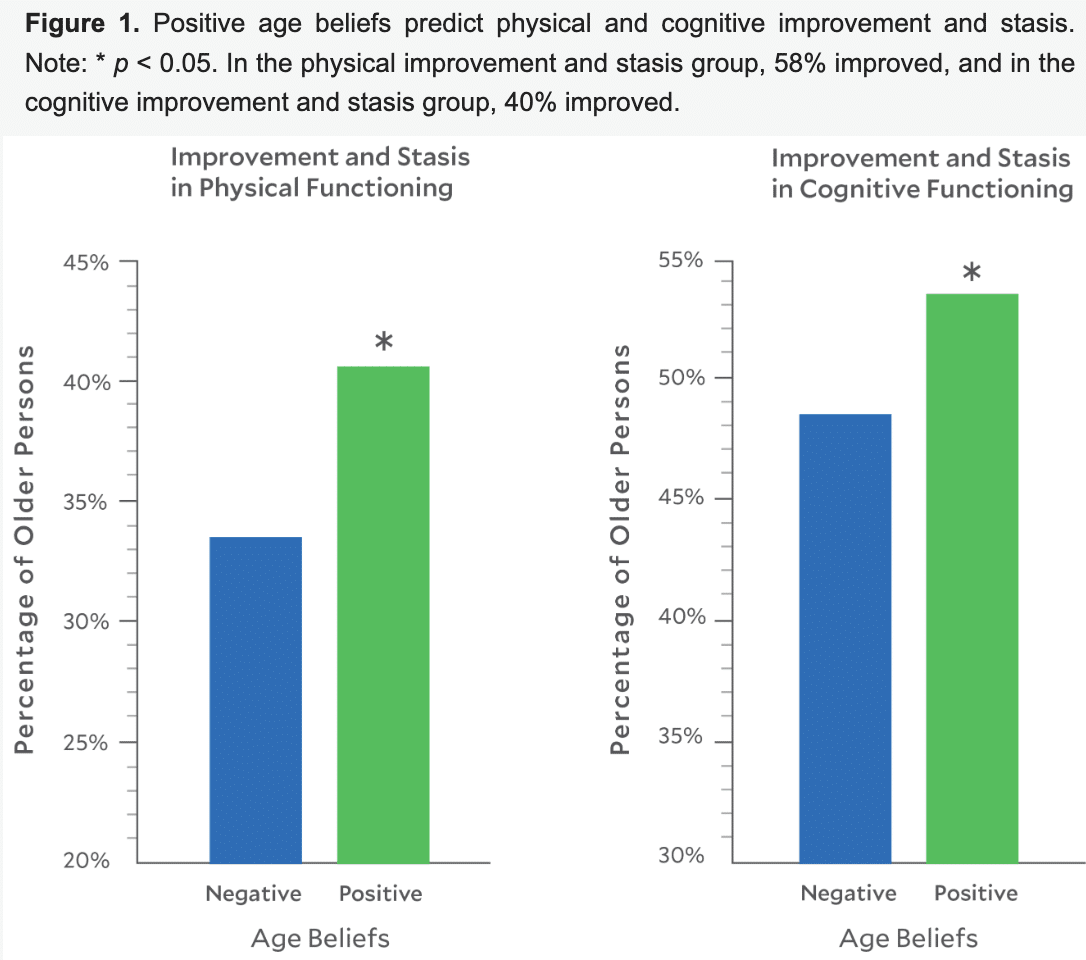
Those with more positive age beliefs were significantly more likely to improve over time.
That doesn’t mean positive thinking is a treatment.
A positive attitude won’t reverse arthritis or magically eliminate disease.
But beliefs influence behavior. They influence motivation, engagement, resilience, stress physiology, and the choices we make every day. Expectations shape actions, and actions shape biology.
The researchers suggest chronic stress may be one of the bridges. If we spend years expecting decline, we live with a constant background hum of stress and resignation. Over time, that becomes biologically relevant.
The story we tell ourselves matters.
And this study is not alone.
Vital Creatine
In one of the landmark studies on aging, Yale researcher
Dr. Becca Levy found that individuals with more
positive perceptions of aging lived an average
of 7.5 years longer than those with more negative views.
Another Yale study found that older adults with
positive age beliefs were approximately 30%
more likely to recover from mild cognitive impairment
and return to normal cognitive function.
Meanwhile, neuroscience continues to show us that the brain remains adaptable throughout life. Neuroplasticity—the ability to form new neural connections—does not disappear at retirement age. Learning, exercise, social engagement, challenge, and purpose continue to shape the brain well into later decades.
Research on exercise has demonstrated that physical activity increases levels of brain-derived neurotrophic factor (BDNF), often described as fertilizer for the brain. Movement supports memory, learning, and cognitive resilience.
The famous Nun Study demonstrated how education, purpose, and cognitive reserve can help protect brain function despite age-related changes seen on autopsy.
Research on “SuperAgers” has identified individuals in their eighties whose memory performs similarly to people decades younger.
Studies on purpose and meaning have repeatedly linked a strong sense of purpose to better cognitive outcomes, greater resilience, and longer life.
The common thread running through all of this research is simple:
Human beings retain far more capacity for adaptation than we once believed.
At Sublime Life, we talk often about measuring what matters.
Not simply disease.
Capacity.
Strength.
Balance.
Muscle mass.
VO₂ max.
Cognitive performance.
Connection.
Purpose.
These are not static traits.
They remain trainable throughout life.
The goal is not merely to age by losing less.
The goal is to continue building capacity for as long as possible.
Perhaps the most important takeaway from this research is not that aging is easy.
It isn’t.
Nor is it that everyone will improve.
They won’t.
The lesson is that decline is not the only trajectory available to us.
The future is not predetermined by an average.
You are not a statistic.
You are your own line on the graph.
And a remarkable number of those lines still point upward.
Reflection for the Week
What is one area of your life where you have quietly accepted decline as inevitable?
Strength?
Energy?
Balance?
Memory?
Connection?
Purpose?
Choose one measurable capacity this week and begin training it.
Not because you’re trying to slow aging.
Because you’re still capable of improving.
Practitioner Pick – Adapt Balance
This week’s journal explores an important idea: our beliefs can influence biology, often through the body’s stress response.
While no supplement replaces healthy habits, managing chronic stress remains one of the most important foundations of healthy aging. Elevated cortisol and ongoing stress can affect sleep, energy, mood, cognition, blood sugar regulation, recovery and overall resilience.
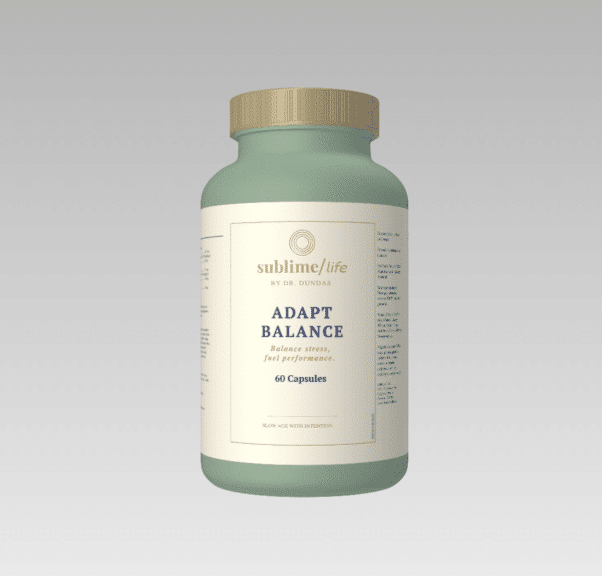
That’s why I formulated Adapt Balance™—
to support the body’s ability to adapt to physical,
emotional, and mental stress while helping maintain
calm focus and steady energy throughout the day.
Adapt Balance combines three clinically studied adaptogens:
These are paired with:
I often recommend adaptogens alongside the fundamentals that truly move the needle:
Because healthy aging isn’t simply about preventing decline—it’s about preserving and building capacity.
At the end of the day, the goal isn’t to eliminate stress. A meaningful life will always include challenges. The goal is to build resilience so that life’s demands require less recovery time, drain less energy, and leave more capacity available for the things that matter most.
We cannot control every challenge life brings, but we can influence how resiliently we respond. Healthy aging is not about becoming fragile with time. It is about continuing to build the physical, mental, and emotional reserves that allow us to keep growing, contributing, connecting, and engaging fully in life for as long as possible.
As always,
Make Presence Your Protocol.
Dr. Kathryn Dundas, MD, CCFP
Founder & Medical Director
Sublime Life