
By Dr. Kathryn Dundas, MD, CCFP
Sublime Life | The Journal
There’s a reason stress changes digestion.
You can feel it almost immediately.
You eat quickly.
Your stomach tightens.
You feel bloated after meals that normally wouldn’t bother you.
Your cravings change.
Your energy drops.
Your body feels inflamed, puffy, reactive.
And yet most people still think digestion begins in the stomach.
It doesn’t.
Digestion begins with safety.
One of the biggest misconceptions in wellness is that gut health is simply about probiotics, elimination diets, or finding the “perfect” supplement stack.
But the gut is not an isolated organ system.
It is a conversation.
Between the nervous system and the microbiome.
Between stress hormones and stomach acid.
Between pace and absorption.
Between the brain and the bowel.
Your body is constantly asking one question:
Is this a safe moment to receive?
Because biologically, survival always comes before digestion.
When cortisol rises chronically, blood flow shifts away from the digestive tract. Motility changes. Enzyme production changes. The microbiome changes.
Even your ability to absorb nutrients changes.
Which means two people can eat the exact same meal and have completely different physiologic outcomes depending on the state of their nervous system.
That matters.
Because in longevity medicine, we often focus on what people are consuming while overlooking the environment the body is receiving it in.
A rushed body processes differently than a regulated one.
This month inside Circle Up, our focus is Gut Health & Microbiome.
But underneath that theme is something deeper:
Flow.
Not productivity.
Not optimization.
Not force.
Flow.
The body was never designed to function in constant constriction.
The gut likes rhythm.
Light.
Movement.
Consistency.
Breathing before meals.
Meals eaten sitting down.
Moments of pause.
Simple things.
Ancient things.
Things we now mistake as “extras” instead of biology.
One of the most overlooked longevity practices is actually learning how to slow down enough for the body to interpret safety again.
Not forever.
Not perfectly.
Just enough.
Enough to digest.
Enough to absorb.
Enough to hear your own signals before they become symptoms.
Because symptoms are often delayed messages.
The body whispers rhythm long before it screams dysfunction.
Lately I’ve been thinking a lot about how many people are trying to “fix” themselves while remaining in the exact physiologic state that helped create the imbalance in the first place.
More supplements.
More trackers.
More stimulation.
More inputs.
But sometimes the intervention is not addition.
Sometimes it’s allowing.
Allowing space between things.
Allowing quiet.
Allowing the nervous system to unclench.
Allowing the body to stop bracing.
There is intelligence in that too.
Science with Soul
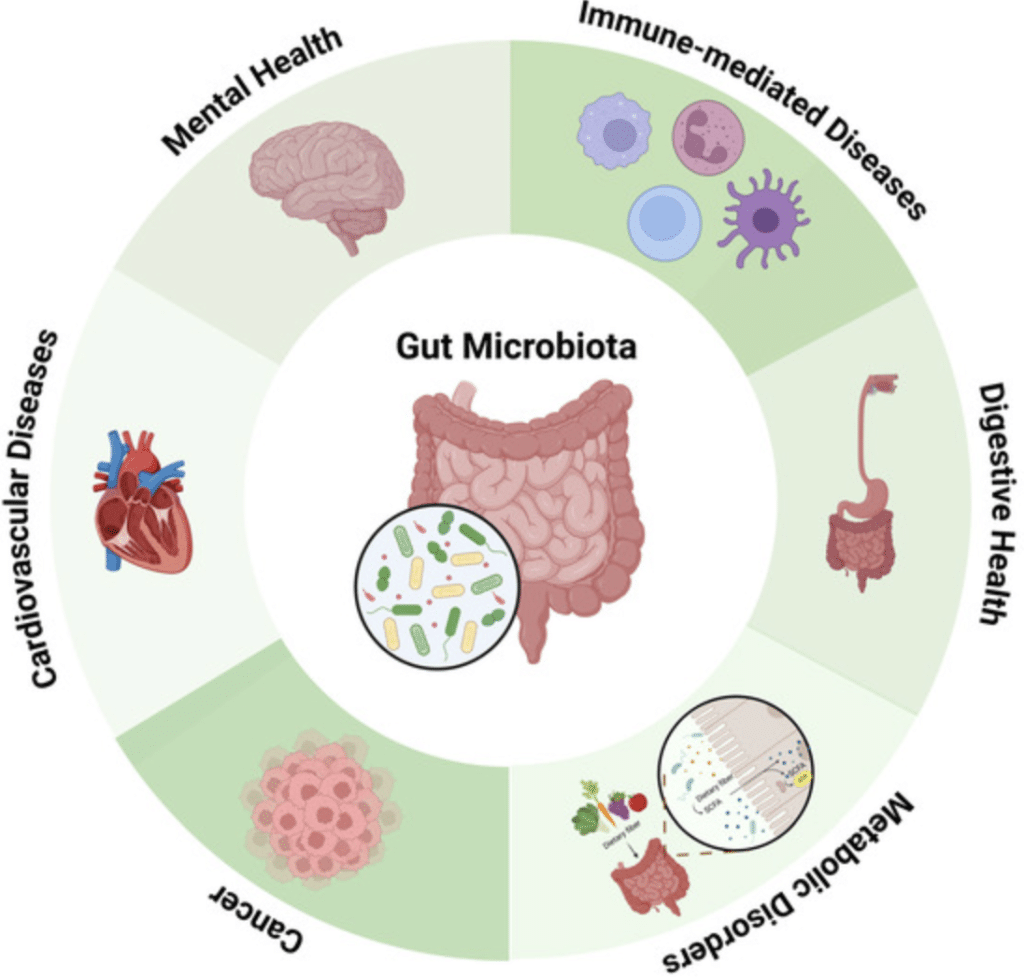
The gut microbiome communicates directly with the brain through the gut-brain axis, vagus nerve signaling, immune pathways, and neurotransmitter production.
Chronic stress has been shown to alter microbial diversity, intestinal permeability, inflammation, and metabolic signaling.
In other words:
Stress doesn’t just change how you feel emotionally.
It changes the ecosystem inside you.
And the opposite is also true.
When we improve sleep, light exposure, movement, breath, nourishment, and emotional regulation, the microbiome often shifts alongside it.
The body responds to rhythm.
This Week’s Ritual
Before one meal each day this week:
That’s it.
Not because slowing down is trendy.
Because physiology changes when the body feels safe enough to receive.
Reflection
Where in your life are you trying to force flow?
And what might change if you stopped pushing long enough to listen?
This month inside Sublime Life, we’ve been exploring the connection between the microbiome, inflammation, mood, energy, and nervous system regulation more deeply.
Sometimes symptoms that appear unrelated — bloating, fatigue, skin flares, brain fog, cravings, joint pain, irregular digestion — are actually part of a larger conversation happening within the gut ecosystem.
A few tools we’re using clinically right now:
Because sometimes healing the gut is less about restriction…
And more about helping the body feel safe enough to restore balance again.
Make Presence Your Protocol ✦ Sublime Life