
The holidays are often described as triggering — and while that word gets overused, there is a very real biological reason this time of year can feel especially hard for some people.
This isn’t about being “too sensitive.”
It isn’t about mindset or willpower.
It’s about how our nervous systems are wired, and how they communicate with one another.
At the center of this is something called mirror neurons.
What mirror neurons actually are
Mirror neurons are specialized brain cells that fire both when you perform an action and when you observe someone else performing that same action.
In other words, your brain partially mirrors what it sees in another person — not metaphorically, but neurologically.
A simple everyday example:
Have you ever noticed that when someone yawns, you suddenly feel the urge to yawn too?
You might even say, “You just made me yawn.”

That’s not imagination or suggestion.
That’s mirror neurons.
Your brain observes the yawn, and the same neural circuits involved in yawning activate in you, even though you didn’t choose it consciously. The body mirrors the action automatically.
Mirror neurons are why yawns — and emotions — are contagious.
The same process happens — far more subtly — with:
Which is why we can “catch” calm…
and also why we can “catch” tension.
Mirror neurons were first identified in the premotor cortex, but we now know a broader mirror neuron system spans areas involved in:
This system allows humans to:
And it explains why certain people — or certain rooms — can instantly shift how we feel, even before anything is said.
“What state is the other person in — and should I match it?”
At the holidays, when you’re around:
your mirror neuron system picks this up automatically.
You don’t choose it.
You catch it.
That’s why:
Your nervous system is mirroring the room.

Smiling while stressed.
Hosting while overwhelmed.
Saying “I’m fine” while your body says otherwise.
Here’s the truth:
You cannot hide your nervous system.
Even when nothing is said, the body communicates through:
Other nervous systems pick this up instinctively — just like horses do.
When words and body don’t match, the nervous system experiences uncertainty, and uncertainty is activating.
That’s why people often leave gatherings saying:
“Nothing bad happened, but something felt off.”
Something did happen — below words.
Here’s what actually helps.
When someone says:
The nervous system relaxes.
Not because everything is fixed —
but because coherence is restored.
Honesty doesn’t burden others.
It settles them.
Trauma isn’t just a memory problem.
It’s a nervous system imprint.
Many traumatic experiences involve ruptured safety with others — abandonment, unpredictability, emotional volatility.
Because mirror neurons are activated in connection, they also help rebuild safety through connection.
When a dysregulated nervous system is near someone calm and grounded, the brain doesn’t just observe regulation — it begins to copy it.
This is co-regulation.
And over time, it teaches the body:
That’s neuroplasticity — learning safety as a felt state.
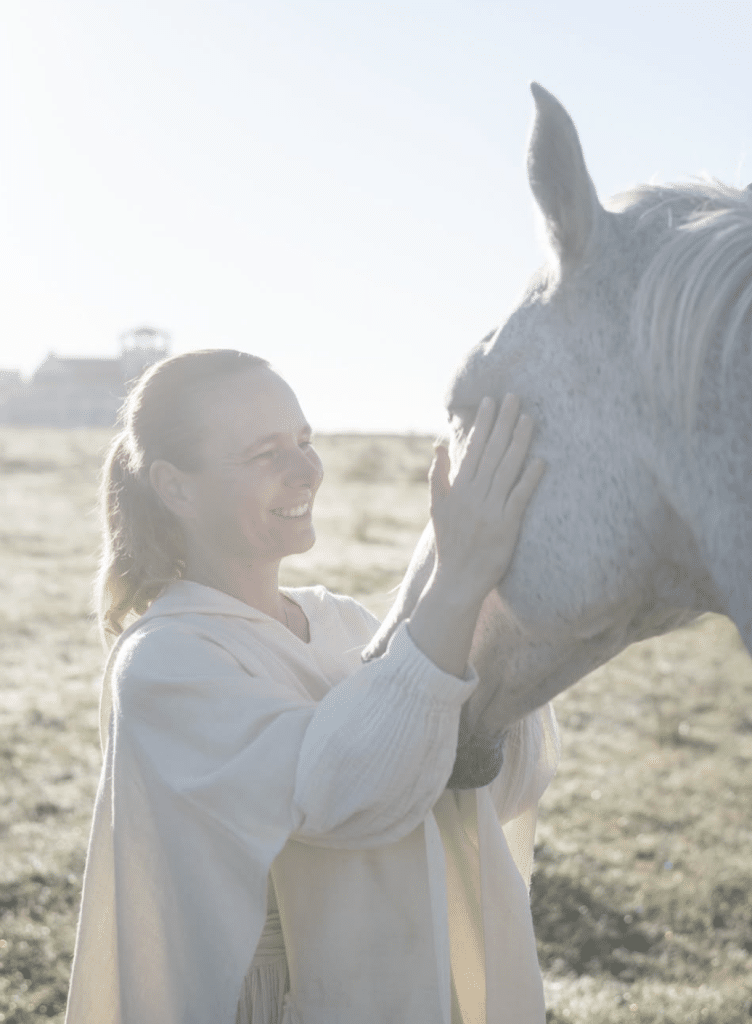
Horses don’t respond to stories.
They respond to states.
They mirror nervous systems instantly — which is why equine-assisted work can be so powerful for trauma, burnout, and nervous-system repair.
This is the foundation of Rewild & Renew.
This year sold out, but we’ll be doing it again next November. If this work resonates, I encourage you to add your name to the waitlist when dates are announced for Uruguay 2026.
A few practical ways to use this intentionally:
Sit near the calmest person. Walk with someone grounded. Spend time with animals, children, or nature.
Slow your breath. Soften your posture. One regulated body can shift a room.
Presence regulates more than words.
Ground yourself before gatherings. Afterward, rest, move gently, or reconnect with someone safe.
A word or gesture with a partner that means: “I need to step out.”
Safety increases simply knowing it exists.
You don’t need to survive the holidays.
You’re allowed to experience them as they are — moment by moment.
In Uruguay, there’s a phrase I love:
“Es lo que fue.”
It is what it was.
Not with resignation — but with gentleness.
You don’t have to fix the past, perform the present, or predict the future.
You just meet this moment with honesty and care.
When you do that — when you regulate, breathe, name what’s true, and stay anchored — your body softens. And from that softness, warmth can return.
Joy doesn’t have to be loud.
It can be quiet, steady, and real.
You are not behind.
You are not failing the season.
Let that be the energy you carry into the room.
And let that be enough.
— Dr. Kathryn Dundas, MD, CCFP
Presence is the protocol.
Sublime Life.