
By Dr. Kathryn Dundas, MD, CCFP
Sublime Life | The Journal
I’ve been watching the science over the past year as it evolves around the mineral lithium and brain health.
It caught my attention for a few reasons.
First, lithium is not just a medication — it’s actually a naturally occurring trace mineral that exists in soil, water, and some foods.
Second, we know something else is happening in our environment.
Soil around the world is gradually becoming depleted of trace minerals, which means the food grown in that soil often contains less of those nutrients than it once did.
Whether that has any implication for brain health — or even for the rising rates of Alzheimer’s disease — we don’t know.
But it’s an interesting question.
And it’s one scientists are starting to explore.
A few studies over the past several years have noticed something intriguing.
When researchers measured lithium levels in the brains of people with Alzheimer’s disease, they found that levels were often lower than in healthy brains.
That observation has led scientists to look more closely at what lithium might actually be doing in the brain.
In laboratory studies, lithium appears to influence several processes involved in neurodegeneration.
It may help:
In experimental models, restoring very small physiological amounts of lithium has been shown to reduce plaque formation and improve memory performance.
Early human studies are also beginning to explore whether low-dose lithium might slow cognitive decline in people with mild cognitive impairment.
One small clinical trial published in JAMA Neurology suggested lithium could slow the progression of cognitive symptoms over time.
One of the challenges with Alzheimer’s disease is that the biological changes often begin 20 to 30 years before symptoms appear. Plaques and tau proteins may quietly accumulate long before memory problems become noticeable. This is why researchers and longevity physicians are increasingly focused on how to support brain health earlier in life rather than waiting until symptoms emerge.
This research is still developing.
But it reminds us of something we see often in longevity medicine.
Sometimes disease is not only about what accumulates in the body.
Sometimes it’s also about what quietly disappears over time.
Another fascinating part of brain health — and one we now understand much better than we did even ten years ago — is the glymphatic system.
You can think of it as the brain’s overnight cleaning system.
While we sleep, cerebrospinal fluid moves through channels in the brain and washes away metabolic waste products — including proteins like amyloid that are associated with Alzheimer’s disease.
This system becomes far more active during deep sleep.
Which means sleep is not just rest.
It’s literally when the brain performs neurological housekeeping.
Research from the University of Rochester first demonstrated that glymphatic clearance increases significantly during slow-wave sleep, helping remove potentially toxic proteins from brain tissue.
When sleep is fragmented or chronically shortened, that cleanup process simply doesn’t run as efficiently.
Over many years, that may contribute to the gradual accumulation of neurological debris.
The brain is also one of the most energy-demanding organs in the body.
It depends on healthy mitochondria, stable glucose metabolism, and adequate nutrients to maintain communication between billions of neurons.
That’s why some of the most powerful strategies for protecting cognitive health are also some of the simplest:
Advanced MRI technology combined with artificial intelligence can now analyze brain structure and compare it to large databases of healthy brains.
These scans can estimate biological brain age and detect subtle structural changes years before dementia develops.
I recently completed one of these scans myself.
The analysis used a technology called BrainKey, which overlays AI analysis onto MRI imaging to evaluate patterns of brain aging.
For patients who are interested, we can help guide you toward centers in the United States that offer this type of testing.
It isn’t necessary for everyone, but for some people it can provide useful information about long-term brain health.
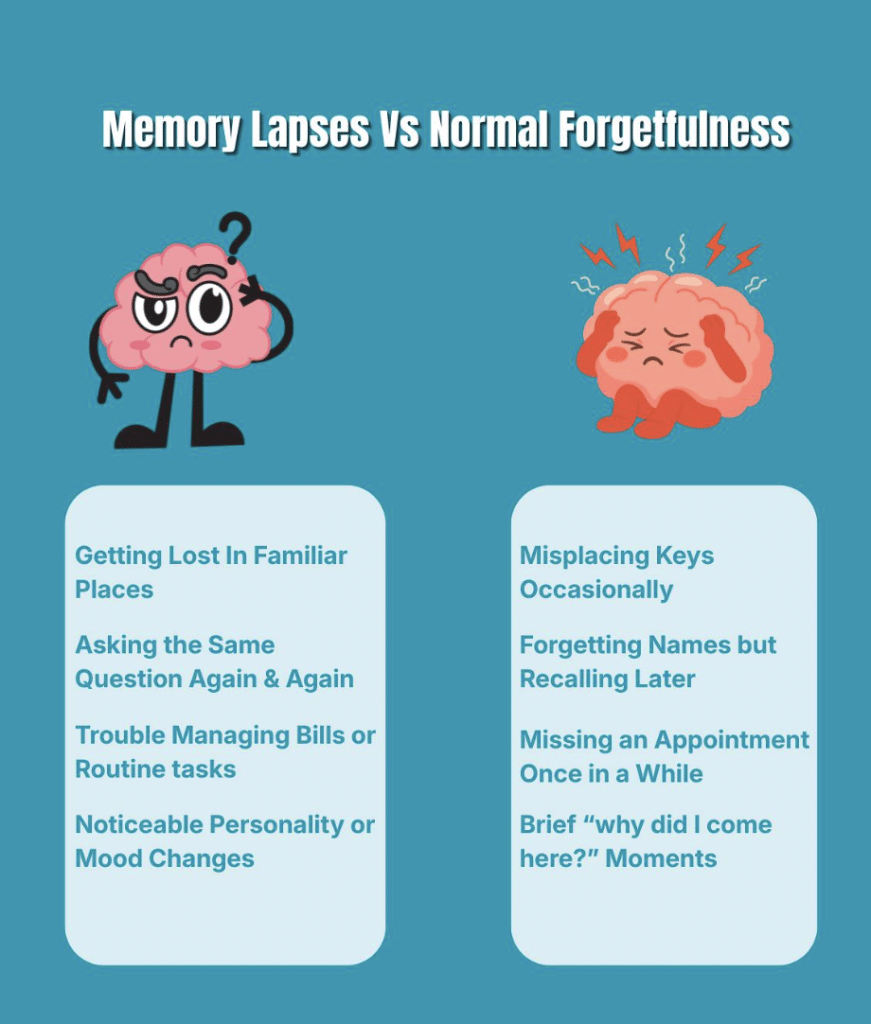
One of the most common questions I hear from patients is:
“How do I know if my memory changes are normal — or something more concerning?”
The truth is that occasional forgetfulness is extremely common.
Misplacing your keys.
Walking into a room and forgetting why you went there.
Momentarily blanking on someone’s name.
Most of the time these moments are not signs of neurodegenerative disease.
They’re usually signs of something much more common in modern life: distraction, stress, poor sleep, or nervous system overload.
When the brain is constantly switching between tasks, notifications, and responsibilities, it doesn’t always encode memories fully in the first place.
In other words, sometimes we don’t remember something because we were never fully present when it happened.
That’s very different from the kind of memory changes we worry about in cognitive decline.
Some earlier red flags that deserve attention include:
These patterns tend to reflect changes in how the brain processes information, not simply momentary lapses in attention.
If you notice these types of changes in yourself or someone you love, it’s worth having a conversation with a physician.
Early evaluation can sometimes identify reversible contributors such as sleep disorders, medication effects, metabolic issues, or nutrient deficiencies.
And in some cases, early detection allows us to support brain health long before significant decline occurs.
But it’s equally important not to pathologize every moment of forgetfulness.
Sometimes the best intervention is simply slowing down, regulating the nervous system, and becoming more present again.
When attention improves, memory often does too.
Small Ways to Support Cognitive Resilience
When it comes to the brain, there is rarely a single solution.
Instead, resilience usually emerges from many small supportive inputs working together.
For some people, that may include targeted nutrients.
For example, L-theanine, an amino acid found in green tea, has been studied for its ability to promote calm focus and support healthy brain wave activity.
Therapies that support circulation and cellular energy may also play a role in overall neurological health.
Thermal therapy, such as sauna exposure, has been associated with reduced dementia risk in long-term population studies, likely through effects on vascular health and metabolic function.
Red and near-infrared light therapies are also being studied for their potential influence on mitochondrial function and neuronal repair.
When we talk about longevity, it’s easy to focus on muscles, metabolism, or cardiovascular health.
But ultimately, the quality of our later years depends profoundly on the health of the brain.
Memory.
Curiosity.
Creativity.
Connection.
These are some of the things that make a long life meaningful.
The science of brain aging is still unfolding.
But what we’re learning again and again is that the brain is not fragile.
It is remarkably responsive to the environment we create around it.
Sometimes the most powerful interventions aren’t dramatic.
They are the quiet daily choices that protect the brain’s ability to rest, repair, and stay engaged with the world.
And perhaps that is the most hopeful part of all — that the choices we make today are quietly shaping the health of the brain we will carry with us for decades to come.
What are you doing today that your future brain will thank you for?
Sometimes brain health isn’t about doing more.
It’s about creating the conditions where the brain can rest, repair, and clear what it no longer needs.
Sleep.
Movement.
Time away from constant stimulation.
Moments where the nervous system can return to baseline.
These small daily rhythms matter more than we once realized.

Service: Graphene Sauna Membership
At Sublime Life, we offer a graphene sauna that patients can access through a monthly membership.
Thermal therapy has been associated in long-term population studies with lower rates of cardiovascular disease and dementia, likely through its effects on circulation, vascular health, and metabolic resilience.
Many patients choose to combine sauna sessions with our full-body red and near-infrared light bed, currently the only FDA-cleared red/infrared light bed available. It delivers wavelengths studied for cellular repair and mitochondrial function.
Using the two together creates a powerful recovery protocol that supports circulation, cellular energy, and nervous system restoration.
An amino acid naturally found in green tea, L-theanine has been studied for its ability to support calm focus and promote healthy alpha brain wave activity.
It’s something I often recommend for people who feel mentally “wired” in the evening and want help transitioning the nervous system toward a more relaxed state before sleep.
Taken in the evening, it can help the brain shift toward the kind of calm state that supports deeper restorative sleep.
For those who enjoy exploring the science more deeply, here are a few studies worth looking at:
Forlenza OV et al.
Long-term lithium treatment reduces cognitive decline in amnestic mild cognitive impairment.
Nunes MA et al.
Microdose lithium treatment stabilized cognitive impairment in Alzheimer’s disease.
Xie L et al.
Sleep drives metabolite clearance from the adult brain.
Laukkanen T et al.
Sauna bathing is associated with reduced risk of dementia and Alzheimer’s disease.
Dr. Kathryn Dundas, MD, CCFP
Founder, Medical Director Sublime Life